
My Lesson Plans for Teaching about the Significance of the French Alliance SSUSH4b
I’m excited to share my lesson plans for teaching the reason for and significance of the French alliance! My plans are designed for 1 day of a class period lasting around 90 minutes. Remember, you know your students best! Your students may complete tasks at a different pace from mine.
As you’ll know soon, I love to incorporate ELA and Reading standards into social studies lessons. So, many activities revolve around nonfiction reading and R.I. Standards.
We’re covering SSUSH4b. Explain the reason for and significance of the French alliance and other foreign assistance including the diplomacy of Benjamin Franklin and John Adams.
FREE Printable Version
Get this lesson plan and materials in the printable version
Bell-Ringers
Imagine you are a small army fighting a much larger, better-equipped opponent. What resources or alliances would you try to secure?
Students write, then discuss in pairs.
TEACH:
Mini-Lesson/Guided Notes (15–20 minutes)
Highlight key points:
British advantages (population, military training, ships, weapons, finances).
Continental Congress limitations (revenue, taxation, army size).
Efforts by Franklin and Adams in Europe.
French, Spanish, and Dutch support (military, financial, naval).
Role of alliances in pivotal victories (e.g., Yorktown).
Show visuals: map of European alliances, images of Franklin in France, French troops and ships (view suggestions in the Materials tab).
2. MODEL - (10 minutes). Use a problem/solution chart.
- Example: Problem: Colonists outnumbered and outgunned by Britain → Action/Alliances: Franklin gains French support → Effect/Impact: French troops and naval support help win the Battle of Yorktown.
- Demonstrate how to extract evidence directly from the reading packet or a primary source excerpt (e.g., Franklin’s letters to the French government).
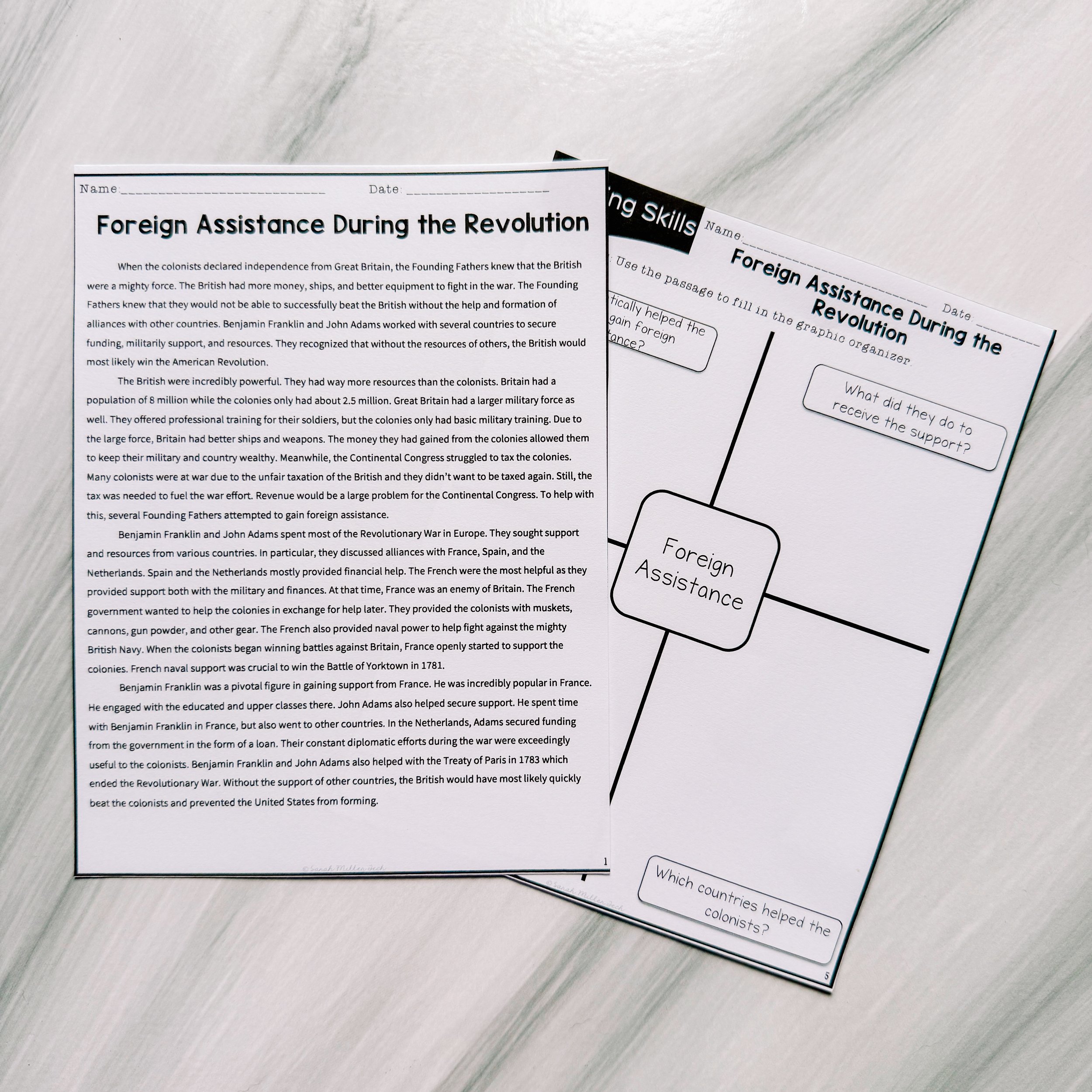
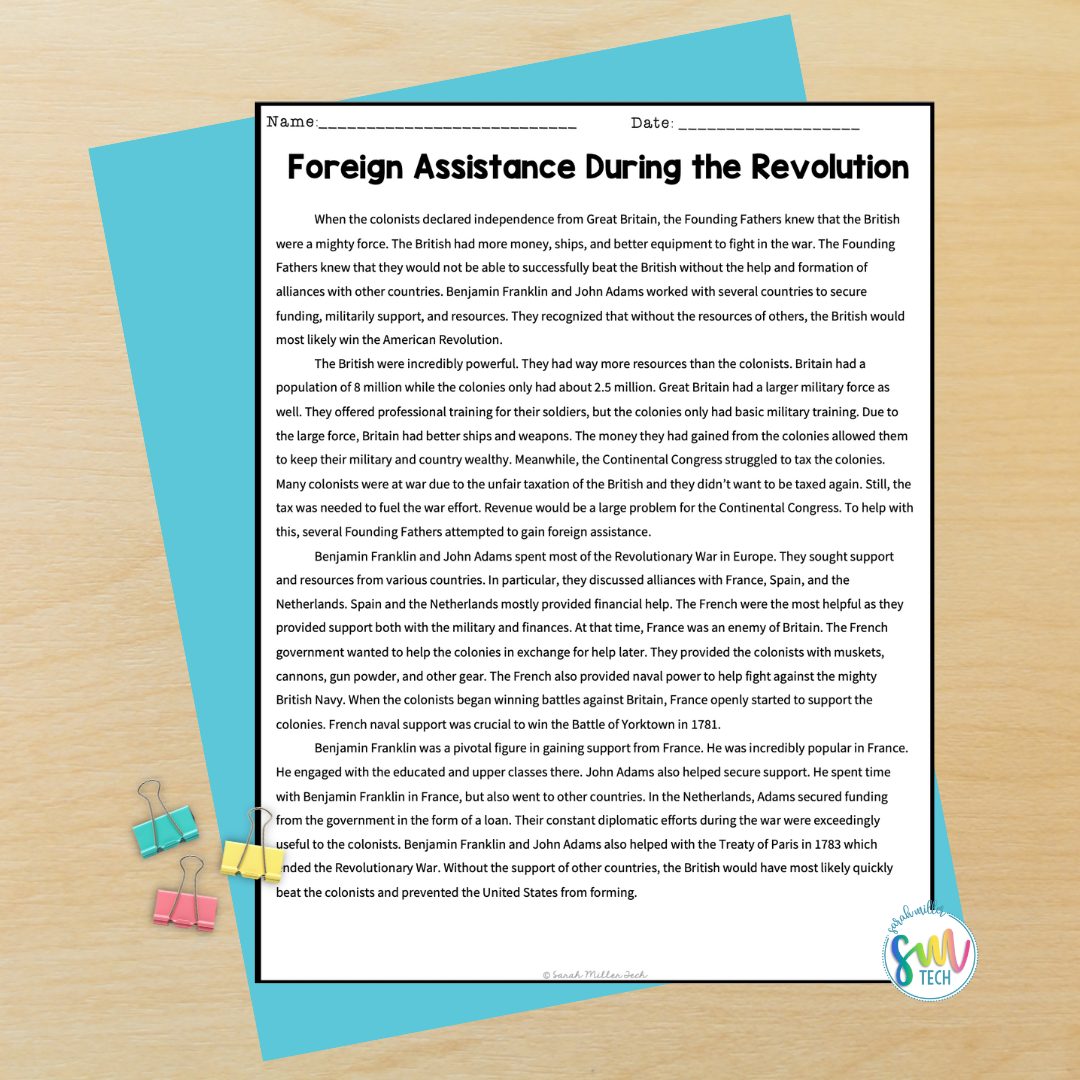
3. PRACTICE - Nonfiction Reading Packet (20 Minutes). Read (independently or in pairs) the nonfiction reading packet and complete the graphic organizer on pg. 7. Discuss whole-group.
4. MODEL - (10 minutes). Use a problem/solution chart.
- Example: Problem: Colonists outnumbered and outgunned by Britain → Action/Alliances: Franklin gains French support → Effect/Impact: French troops and naval support help win the Battle of Yorktown.
- Demonstrate how to extract evidence directly from the reading packet or a primary source excerpt (e.g., Franklin’s letters to the French government).
5. PRACTICE - Nonfiction Reading Multiple Choice & Writing Prompt (20 minutes) Complete pages 4-5 of the nonfiction reading packet.
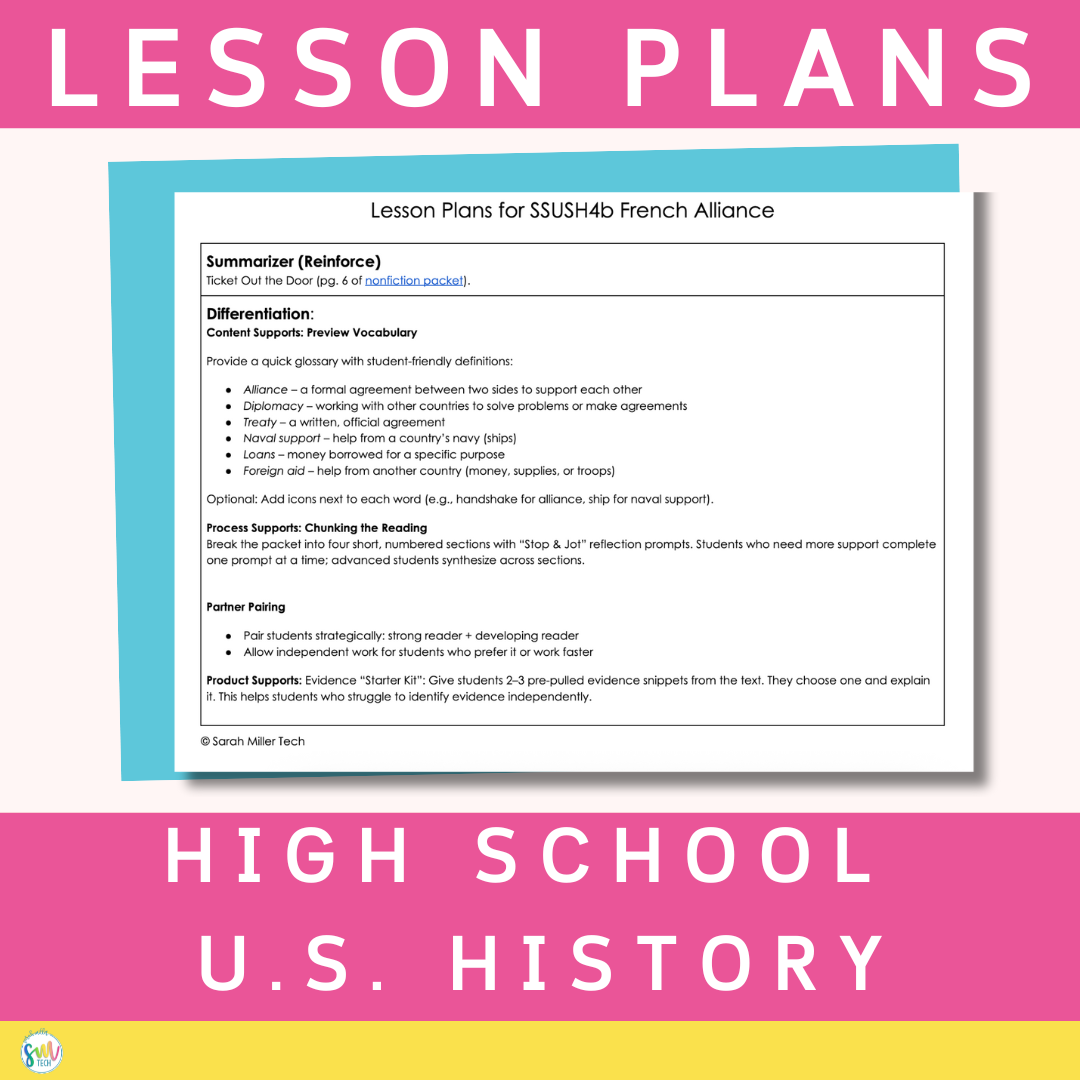
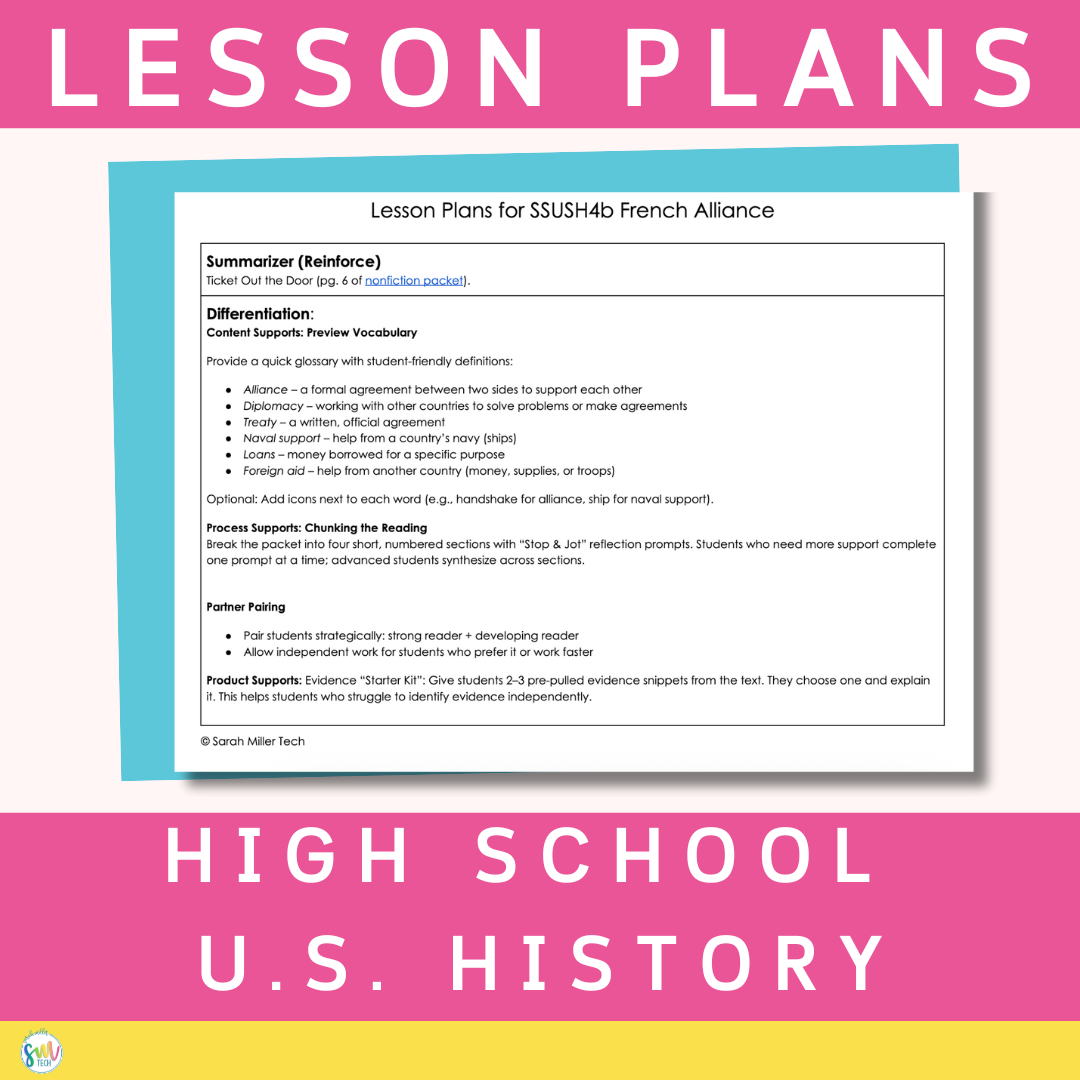
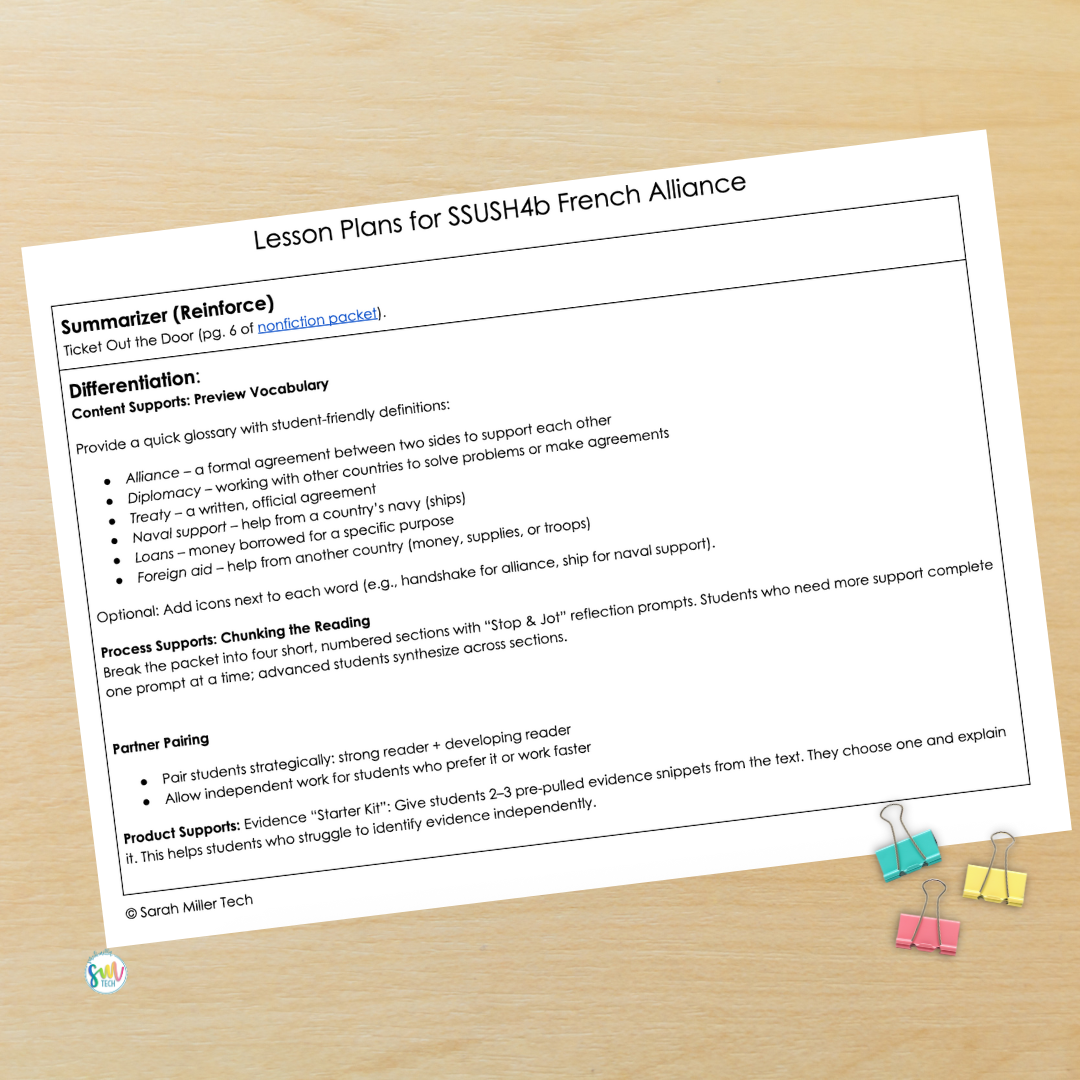
Summarizer (Reinforce)
Ticket Out the Door (pg. 6 of nonfiction packet).
Differentiation Ideas
Content Supports: Preview Vocabulary
Provide a quick glossary with student-friendly definitions:
Alliance – a formal agreement between two sides to support each other
Diplomacy – working with other countries to solve problems or make agreements
Treaty – a written, official agreement
Naval support – help from a country’s navy (ships)
Loans – money borrowed for a specific purpose
Foreign aid – help from another country (money, supplies, or troops)
Optional: Add icons next to each word (e.g., handshake for alliance, ship for naval support).
Process Supports: Chunking the Reading
Break the packet into four short, numbered sections with “Stop & Jot” reflection prompts. Students who need more support complete one prompt at a time; advanced students synthesize across sections.
Partner Pairing
Pair students strategically: strong reader + developing reader
Allow independent work for students who prefer it or work faster
Product Supports: Evidence “Starter Kit”: Give students 2–3 pre-pulled evidence snippets from the text. They choose one and explain it. This helps students who struggle to identify evidence independently.
Environment Supports: Quiet Work Zone vs. Collaborative Zone. Allow students to choose the environment that works best for them.
Behavior/Executive Function Supports:
Clear Time Breakdowns. Use timers and agenda checklists;
Task Cards
During the reading activity, provide each student (or each group) with task cards such as:
“Identify the most important reason the colonies needed help.”
“Highlight one piece of evidence that shows diplomacy mattered.”
“Find evidence of foreign military support.”
Enrichment Supports: Map Analysis: Compare a map of alliances in 1778 to one after the Treaty of Paris (1783).
Diplomatic Role-Play Prep: Write a 1-minute pitch as Benjamin Franklin trying to convince a European monarch to help.
FREE Lesson Plan Printable
Grab this lesson plan and in the printable version.